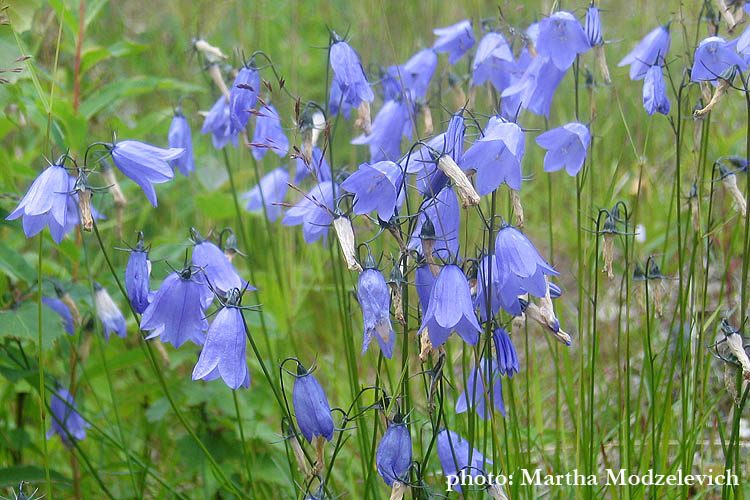
| Scientific name: | Campanula rotundifolia L. | |
| Synonym name: | Campanula groenlandica Berlin (ssp. groenlandica) | |
| Swedish name: | Liten blåklocka, blåklocka | |
| German name: | Rundblättrige Glockenblume | |
| Nederlandse naam: | Grasklokje | |
| English name | Harebell,Bluebell | |
| Plant Family: | Campanulaceae, Klockväxter, Bellflower family |
|
|
| Life form: | Rhizomatous perennial | |
| Stems: | Height 10–60 cm, many-stemmed; along the slender central stem are alternate leaves, and terminates in either a solitary flower, or a short raceme of 2-3 flowers | |
| Leaves: | Rootleaves are round, linear leaves on the flowering stems | |
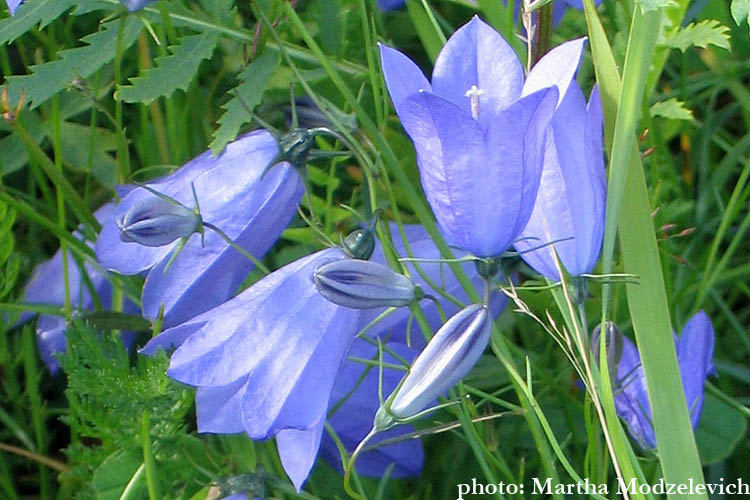
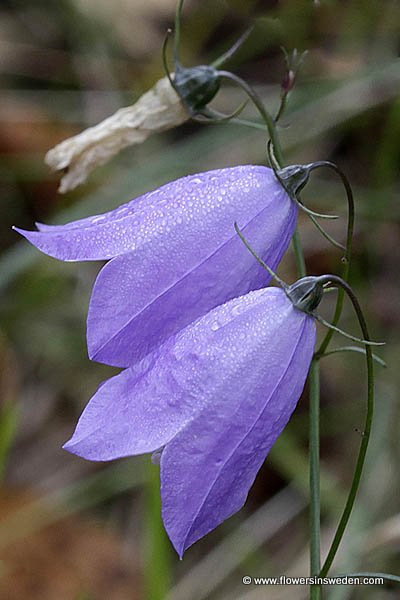
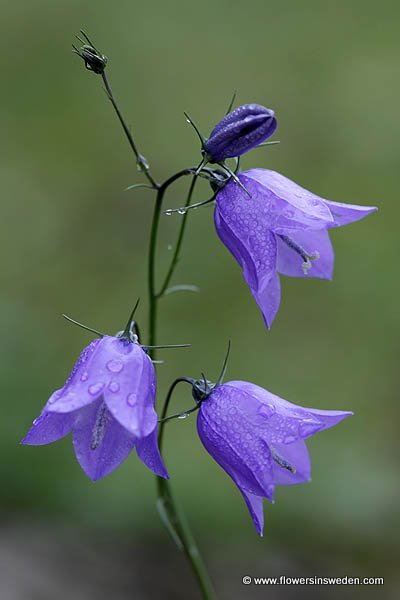
| Flowers: | Corolla, 5 short lobes that curve outward; interior of flower white or pale violet near the base, while a long violet style projects slightly beyond the outer rim of the corolla; style terminates into a tripartite white stigma. | |
| Flowering Period: | July-September | |
| Fruits: | Capsule, round, slightly longer than broad, glabrous, strongly veined, nodding | |
| Habitat: | Woods, thickets, moorland, coast, pastureland, meadow, farmland and settlements |
Derivation of the botanical name: Campanula is diminutive of Late Latin campāna, bell (New Latin: a little bell), rotundifolia, rotund, "round, spherical," i, connective vowel used by botanical Latin,and foli, "leaf". groenlandica, from Greenland.
|