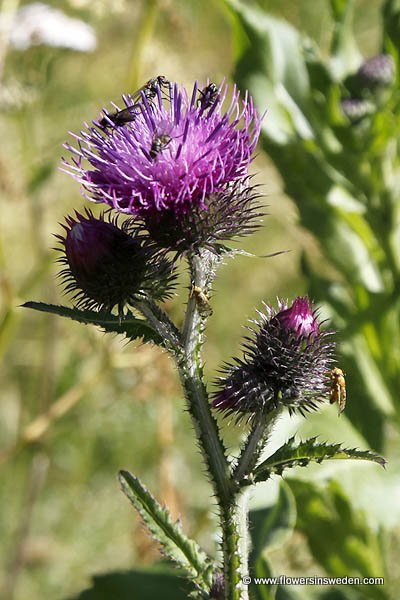
| Scientific name: | Carduus crispus L. | |
| Swedish name: | Krustistel | |
| German name: | Krause Distel | |
| Nederlandse naam: | Kruldistel | |
| English name: | Curly plumeless thistle, Welted thistle | |
| Family: | Asteraceae, Sunflower family, Korgblommiga växter |
|
|
| Life form: | Perennial | |
| Stems: | Height 50–180 cm, erect, continuously spiny-winged up to or nearly up to capitula | |
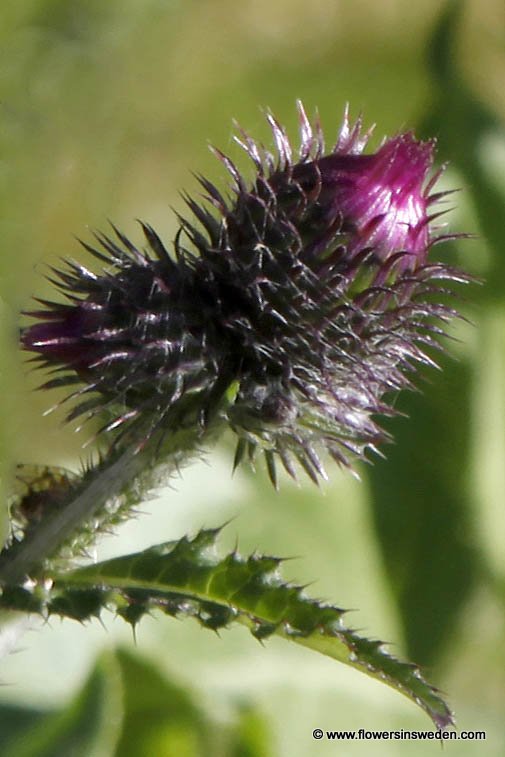
| Leaves: | Basal, cauline leaves, blade margins, dentate, spiny, subglabrous on lowerside; heads in groups of 3–5 | |
| Flowers: | Dense terminal head of numerous tubular, bisexual disc-florets grouped together on a common receptacle | |
| Flowering Period: | June, July, August, September | |
| Fruits: | Cypsela, yellowish-brown, slightly flattened, smooth, crowned by a pappus of straight long hairs | |
| Habitat: | Throughout the country, cultivated land, roadsides, pastures and fields. |
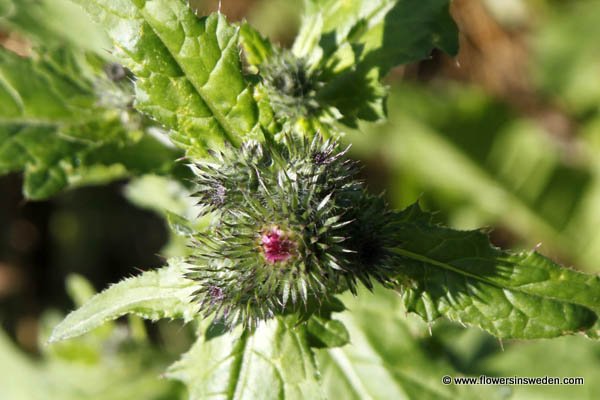
Derivation of the botanical name: Carduus, thistle, the classical name. crispus, curled; curly haired.
It is a favorite foodplant of caterpillars of the Painted Lady, Vanessa cardui [(Linnaeus, 1758) Synonym: Papilio cardui (Linnaeus, 1758)], which derives its specific name from their preference for thistles. 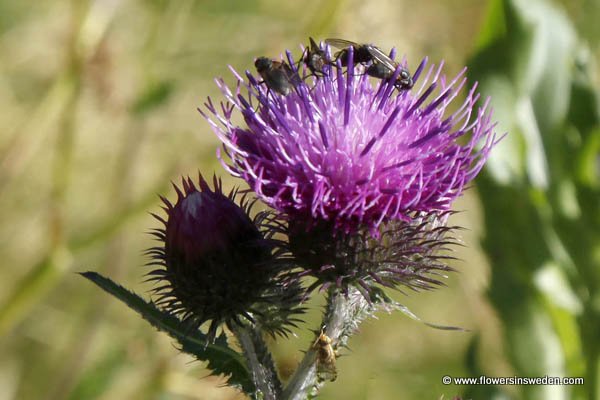
|