|
|
| Life form: |
| Perennial herb |
| Stems: |
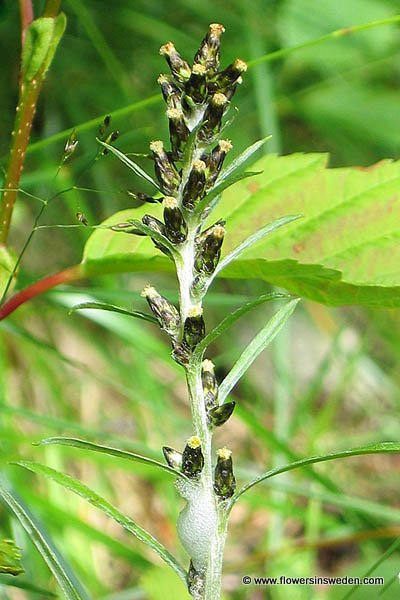
| Solitary; upright, not branched, tomentose |
| Leaves: |
| Alternate, basal leaves elongate, green on top, white-felted beneath. Upper leaves stalkless, linear. Leaves with one vein, rarely also with two unclear lateral veins, dull green and sparsely hairy above, densely white-downy beneath. |
| Flowers: |
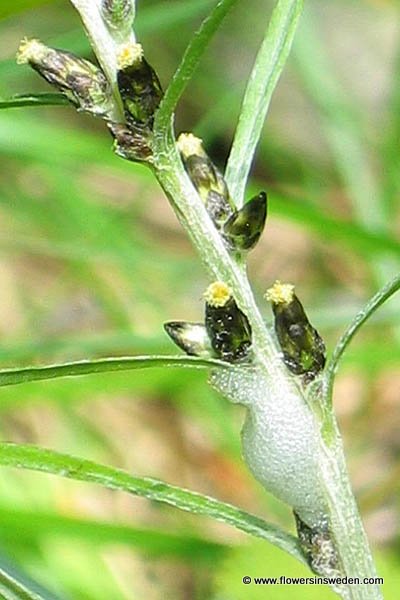
| Pale brown tubular florets grouped together into small flower-like heads (capitula), 5–7 mm long. Outer florets pistillate, the few disc-florets bisexual. Corolla of 5 fused petals. Calyx modified into a ring of hairs (a pappus). Stamens 5, anthers united into a tube around the style. Pistil of 2 fused carpels, style solitary, stigma 2-lobed. Capitulum subtended by involucral bracts which are glossy and have a brownish, rarely dark brown tip, inner equalling the florets. Capitula borne in a spike, the whole inflorescence usu. longer than a third of the stem. |
| Flowering Period: |
| July, August |
| Fruits: |
| Achene 1-5mm, hispid; pappus reddish |
| Habitat: |
| Forest,thicket, heath, coast, farmland, settlements |
Derivation of the botanical name:
Gnaphalium from Greek gnaphalon, "a lock of wool," describing these plants as floccose-wooly.
sylvaticum, sylvan, "of or growing in woods".
- The standard author abbreviation L. is used to indicate Carl Linnaeus (1707 – 1778), a Swedish botanist, physician, and zoologist, the father of modern taxonomy.
- The standard author abbreviation Sch. Bip. & is used to indicate Carl Heinrich 'Bipontinus' Schultz (1805 – 1867), a German physician and botanist, and a brother to Friedrich Wilhelm Schultz (1804 – 1876)
- The standard author abbreviation F. W. Schultz is used to indicate Friedrich Wilhelm Schultz (1804 – 1876), a German pharmacist and botanist.
|