|
|
| Life form: |
| Perennial herb |
| Stems: |
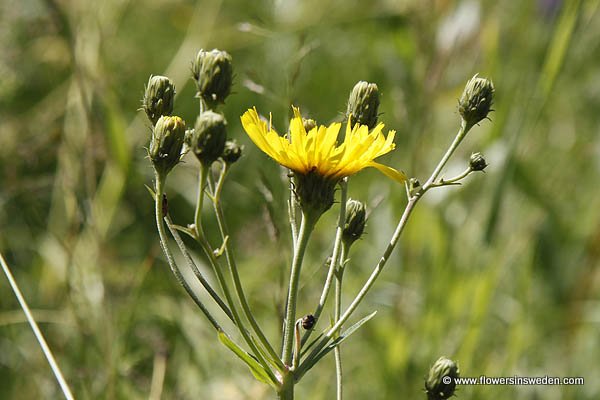
| Flower stalks are covered in fine short hairs,; tingued with red, lower stem may be finely hairy or smooth, waxy in part, hairs becoming short and fine towards the tips. |
| Leaves: |
| Alternate, usually with many rough hairs especially at the edges and with long hairs beneath, bases narrow but usually not clasping the stem |
| Flowers: |
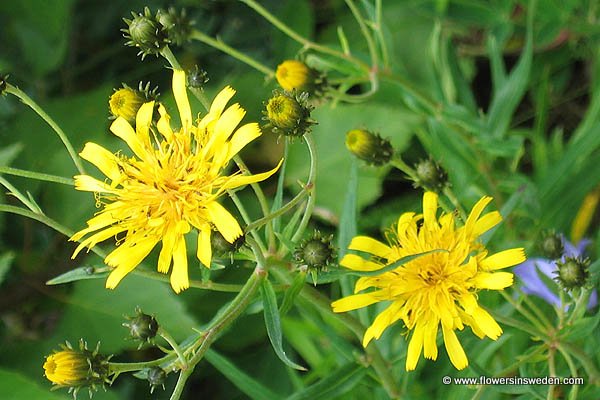
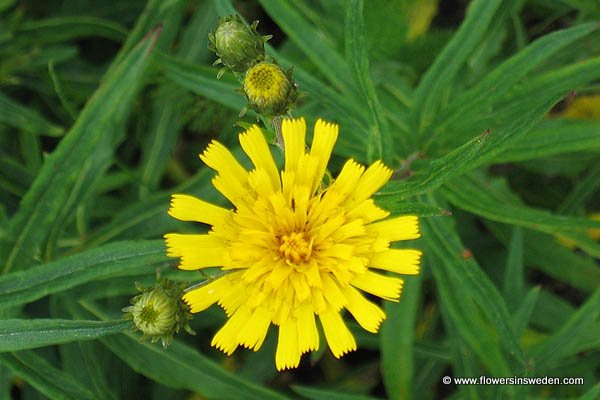
| Loose, branched cluster of yellow flowers |
| Flowering Period: |
| June, July, August |
| Fruits: |
| Dry seeds that ripens to black, with a tuft of light brown hair to carry it off in the wind. |
| Habitat: |
| Forest, thickets, settlements |
Derivation of the botanical name:
Hieracium from ancient Greek hierax, "a hawk". Pliny the Elder (23-79 CE) believed that hawks fed on this plant to strengthen their eyesight and thus it became the Greek and Latin name for this and similar plants, called hawkweed.
umbellatum, umbella, "umbrella", like umbels or umbrella-like flower heads. Literally: a little shadow.
- The standard author abbreviation L. is used to indicate Carl Linnaeus (1707 – 1778), a Swedish botanist, physician, and zoologist, the father of modern taxonomy.
- The standard author abbreviation Michx. is used to indicate André Michaux (1746 – 1803), a French botanist and explorer.
|