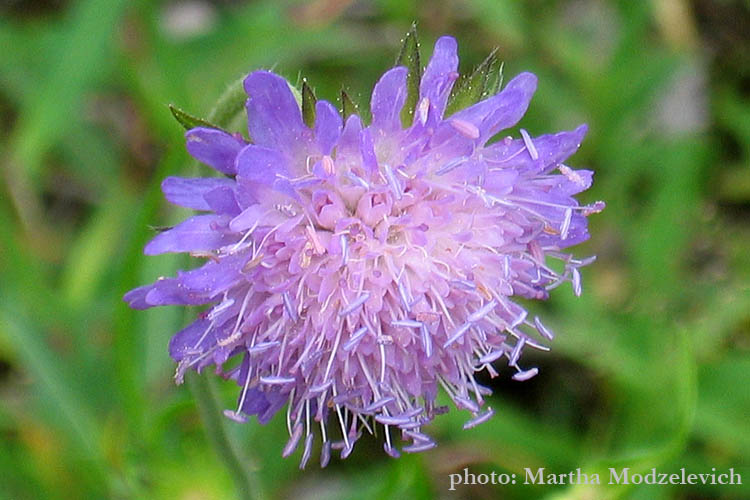
| Scientific name: | Knautia arvensis (L.) Coult. | |
| Synonym name: | Scabiosa arvensis L., Trichera arvensis (L.) Schrad. | |
| Swedish name: | Åkervädd | |
| German name: | Wiesen-Witwenblume | |
| Nederlandse naam: | Beemdkroon | |
| English name: | Field Scabious | Plant Family: | Dipsacaceae, Åkerväddar, Teasel family |
|
|
| Life form: | Perennial | |
| Stems: | Round, slightly branched, 60-90 cm high, somewhat coarse with short, whitish hairs and rather bare of leaves, except at the base | |
| Leaves: | Basal rosette, compound. The leaves at the stem are opposite, the lower ones have petioles, are of a lanceolate shape, have serrate margins and are often pinnate.The middle and upper leaves are sessile, pinnate with 3 - 6 segments at each side | |
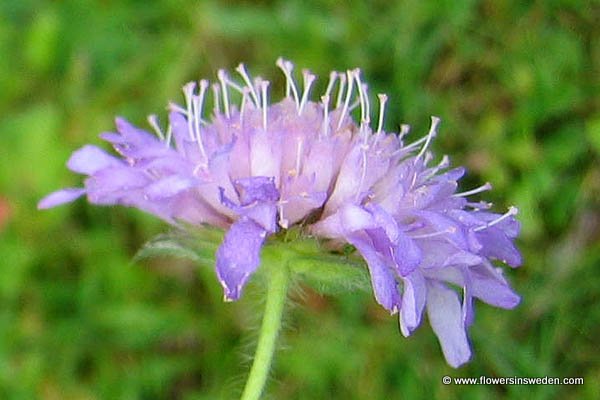
| Flowers: | violet-blue flowers | |
| Flowering Period: | June-August | |
| Fruits: | Rather large, somewhat four-cornered and crowned by several short, bristly hairs that radiate from its summit | |
| Habitat: | Woods, thickets, pastureland, meadows, farmland and settlements |
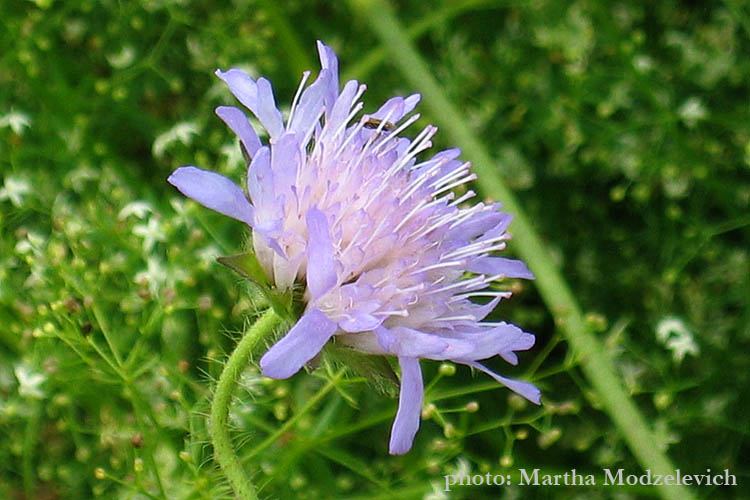
Derivation of the botanical name: Knautia, the genus, dedicated to Christoph Knaut (1638-1694), German botanist and doctor and his brother Christian (1654-1715). arvensis, "of planted fields". Scabiosa, Latin scabies, "the itch," which the rough (scurfy) leaves might have been used to cure.
|