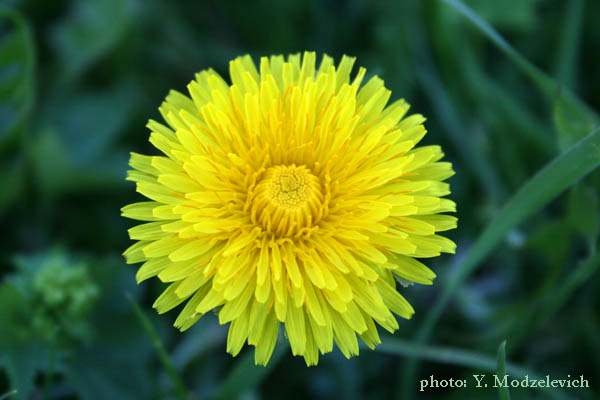
| Scientific name: | Taraxacum sect. Ruderalia Kirschner, H. Øllg. & Stepanek | |
| Synonym name: | Taraxacum sect. Vulgaria (Lam.) Schrank | |
| Swedish name: | Maskros, Ogräsmaskros | |
| German name: | Wiesen-Löwenzahn, Gemeiner Löwenzahn | |
| Nederlandse naam: | Paardenbloem | |
| English name: | Common Dandelion | |
| Family: | Asteraceae / Compositae, Korgblommiga växter |
|
|
| Life form: | Herbaceous perennial | |
| Stems: | Plant medium-sized (20–45 cm). | |
| Leaves: | Basal rosette,long, lance-shaped, deeply toothed | |
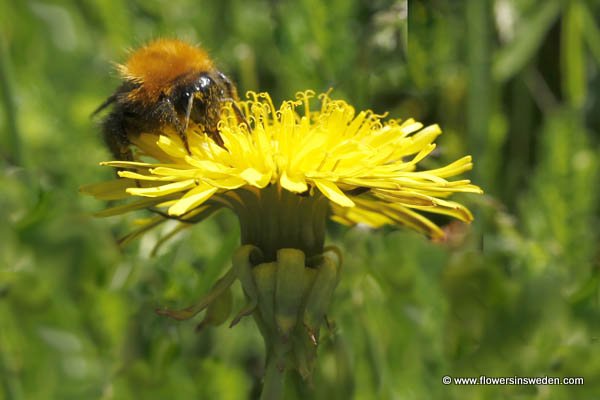
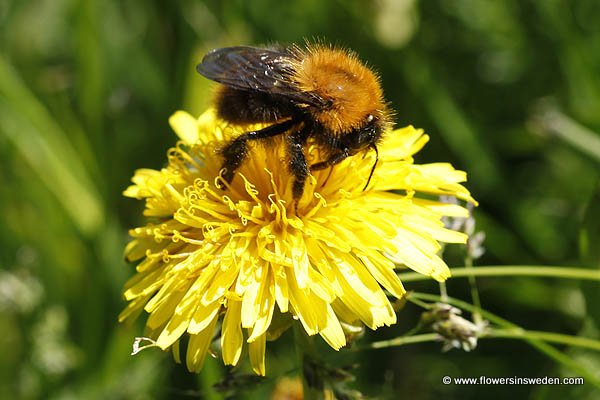
| Flowers: | Each flower head consists of hundreds of tiny yellow ray flowers. Unlike other composites, there are no disk flowers. | |
| Flowering Period: | April-October | |
| Fruits: | Achene straw-coloured or greyish brown; Achene spinules medium long, medium strong, straight. Achene cone cylindrical, smooth, 0.7–0.8 mm long. Rostrum length 10–11 mm. | |
| Habitat: | Meadows, pastureland, farmland, settlements |
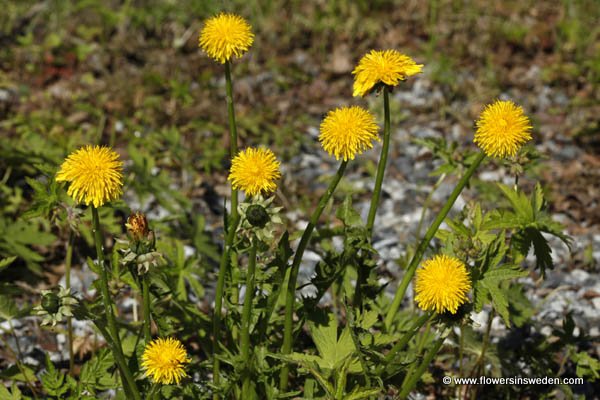
Derivation of the botanical name: Taraxacum, medieval name traceable through Arabic to the Persian talkh chakok, meaning "bitter herb". Ruderalia, growing among rubbish.
White, globular seed head. Each seed has a tiny parachute, to spread far and wide in the wind. The long, lance-shaped, deeply toothed leaves gave the plant its name in Old French: Dent-de-lion means lion's tooth in Old French. 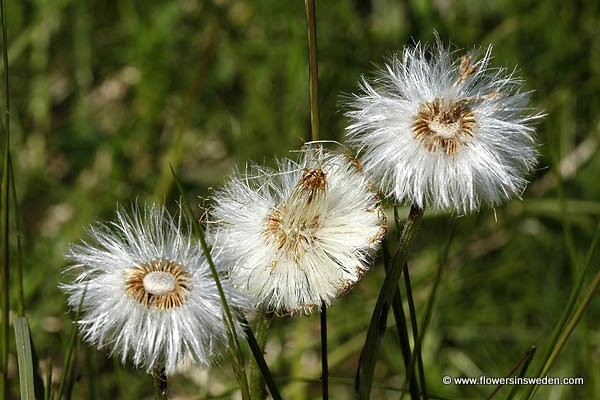
|